“Feminism: The advocacy of women’s rights on the grounds of the equality of the sexes."
“Egalitarianism: The doctrine that all people are equal and deserve equal rights and opportunities.”
The two quotes above are sourced from the Oxford Dictionary. On the
face of it, feminism and egalitarianism appear to converge. Indeed, it
is not unusual to hear feminists appeal to this dictionary definition
whenever they are challenged. I will call this the “reasonable person”
defence, e.g., What reasonable person could possibly disagree? The point
being, they can't. Not if they want to remain reasonable in the eyes of
others,
But similarly, what reasonable person could disagree with
egalitarianism? Both premises are highly reasonable. But as numerous
studies and surveys have demonstrated, a majority of people support
egalitarian values but do not identify as feminists.[1] [2] [3] [4]
What's going on? Are these people confused, ignorant, or both?!
Neither.
It seems the non-feminist (not anti-feminist) egalitarian majority
either know or intuitively suspect a crucial difference between the
goals
of egalitarianism and feminism. Unfortunately, looking to dictionary
definitions does not help us articulate what these differences are.
A visit to the Stanford Encyclopedia of
Philosophy
gives us a more detailed description of both concepts. The opening
preamble to the egalitarian chapter[5] dovetails nicely with the
dictionary definition above. The feminist chapter, however, quickly
diverges from the dictionary definition, running off into various
strands where the key theme is internal disagreement within feminism
about what feminism is. It takes just over 3,000 words before the term
patriarchy first appears but when it does, it is neither problematic nor
contested.
“Feminism, as liberation struggle, must exist apart from and as a
part of the larger struggle to eradicate domination in all its forms. We
must understand that patriarchal domination shares an ideological
foundation with
racism
and other forms of group oppression, and that there is no hope that it
can be eradicated while these systems remain intact. This knowledge
should consistently inform the direction of feminist theory and
practice. (hooks 1989, 22)”[6]
Here is the first hint of what differentiates feminism from
egalitarianism. You will note there is no mention of equality by hooks;
the goal is “liberation” from “patriarchal domination.”
Ask a feminist what feminism means and you are likely to get one of
two responses. The "reasonable person" defence is one, while the other,
is what I will call the "atomistic dodge." This entails the feminist
stating that feminism is not a monolithic movement, its aims being too
complex to pin down[7]. This position personifies intersectional
feminism. Note how the descriptions contradict one another. It is easy
to get lost in this equivocal maze.
So, rather than trying to discern the differences between feminist
factions, I asked what they had in common. The results help us see the
difference between egalitarianism and feminism.
In 1963, the liberal feminist Betty Friedan published a book about a
“problem with no name.” Seven years later, radical feminists named it
“patriarchy." Patriarchy was conceived of as the underlying structure
which facilitated men's oppression of women; “a system characterized by
power, dominance, hierarchy and
competition, a system that [could not] be reformed but only ripped out root and branch.”[8]
This moment marked a fundamental change in strategy as feminists
shifted from a liberal policy of achieving equality through reform, to a
radical strategy of trying to dismantle patriarchy. Around this time,
Friedan was unceremoniously kicked out of the organisation she had
founded because she wasn't radical enough[9]. Since this time,
patriarchy has remained central to all subsequent waves of feminism.
While it is true that the different factions of feminisms have slightly
different conceptions of patriarchy, they all agree on the following:
Patriarchy is a socially constructed phenomenon which enforces notions of
sex and gender that equate to male supremacy and female inferiority[10] [11].
Patriarchy is the mechanism by which all men institutionally oppress all women[12].
All feminisms are united in the fight against patriarchy (if little else)[13].
But what is patriarchy? Does it even exist? There is a dearth of
research on feminist premises which values critical thinking over
critical theory, though this is starting to change.[14] Both the
existence and origin of patriarchy are assumed by feminists rather than
explored, yet the flawed, circular logic of the three premises above
represent the ideological bedrock of all feminisms—from radical to
intersectional—and social 'justice' activism today.
The feminist concept of patriarchy is embellished from the
anthropological observation that in many cultures men appear to hold
more social, economic and political 'power' compared to females.
Feminists assume men grasp for power and resources to dominate women
because they hate them (misogyny). My research suggests patriarchy is
vastly more complex than feminists have ever imagined and that women
have just as much influence in its structure and maintenance as men. As
Mary Wollstonecraft noted:
“Ladies are not afraid to drive in their own carriages to the doors of cunning men."[15]
Patriarchy is a system which can both oppress and liberate, both male and female. It is the human fitness landscape.
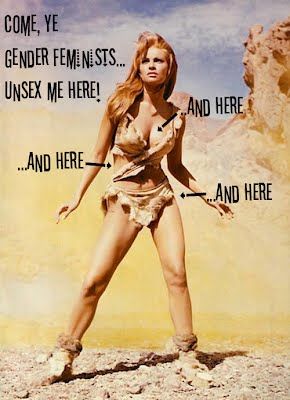
And here lies the rub for feminisms today. Heterosexual men and women
are attracted to one another precisely because of their stereotypical
sexual traits. In fact, they are not stereotypical, they are
archetypical. Humans are a sexually reproducing species. Men and women
have shaped one another physically and psychologically over millions of
years via the process of sexual selection. In turn, we create culture as
our fitness landscape. There is a simple dynamic to this: Men want
power and resources because women want men who have power and resources.
This isn't because women are selfish gold diggers or men shallow
aesthetes. Sexual dimorphism and the sexual division of labour are not
patriarchically imposed tyrannies. They are an elegant and pragmatic
solution for a species who have uniquely helpless infants with
unprecedentedly long childhoods. This dynamic between the sexes, of team
work and strong pair bonds, is one of the foundations of our success as
a species. The survival of offspring is at the centre of this—whether
we choose to have children or not. The sexes simply cannot be understood
except in light of one another and the reason we evolved to
cooperate; offspring. It will continue to be so for as long as we remain human.
The feminist legacy of social constructionism and patriarchy theory
has taken the capricious, delightful and, yes, sometimes cruel battle of
the sexes and turned it into a war of attrition. The circular logic
also has feminism devouring itself from within.
This past year, one of the the most iconic women of the 20th
century, the radical feminist and intellectual, Germaine Greer, was
denied a platform to speak at a UK university.[16] Her crime? Greer does
not reject biology wholesale and, while she respects the egalitarian
rights of men who want to transition and live and
love as a woman, she insists this doesn't actually make them biologically women; they remain
trans-women.
For this she was stripped of the right to speak, verbally abused and
labelled a bigot. The middle class, socialist feminist Laurie Penny went
so far as to cast Greer in the same light as people who want to murder
homosexuals.
Why should women mind? In 2014 a trans-woman in the US was awarded
“working mother of the year” despite neither giving birth or being
primary carer to her children.[17] This year, in 2016, Caitlyn Jenner,
who has been living as a woman for a few months, will be awarded “woman
of the year” ahead of countless women of substance who have made
extraordinary accomplishments
while facing actual selection pressures unique to their biological sex.
Trans-activists are lobbying for a change of language by midwives to
refer to people giving birth as “pregnant persons” not women.[18] At a
time when people debate whether a woman drinking the odd glass of wine
in
pregnancy is
child abuse, a trans-women took powerful (not socially constructed)
hormones
to stimulate lactation[19]. A discussion of the nutritional value of
the milk extends to the trans-mother reporting the milk is thick and
creamy, which seems to identify it as something other than human breast
milk, which is highly dilute and low in fat.
Feminists frequently claim that we live in a rape culture, even though rape and all violent
crime in
the West is in steady decline and rape prosecution statistics are on a
par with other crimes at over 50%.[20] [21] In the US there is a
feminist movement on college campuses to lower the threshold of proof in
rape prosecution trials. It is staggering to think these educated
people have forgotten terrible lessons within living
memory; the bitter crop of strange fruit hanging from the poplar trees.
To balk at this is not hatred or phobia but healthy scepticism. We
are all equal before the law under egalitarianism. This is not the case
with feminism. It places ideology before people. Individual rights and
choices are “problematic”.[22] Women like myself who point out the
logical inconsistencies and totalitarian mission creep of feminism are
labelled anti-feminist and anti-woman; as if “feminist” and “woman” were
synonyms. They aren't. Feminists are identified by their
politics,
not their sex or gender. They do not speak for women or the majority of
egalitarians in society; they speak only for themselves. The dictionary
definition of feminism is in serious need of a rewrite.
The egalitarian quest for equality is tangential to feminism. So...which are you?
*
[1]
http://www.huffingtonpost.com/2015/04/10/feminism-reproductive-rights-la... (link is external)
[2]
http://www.huffingtonpost.com/2013/04/16/feminism-poll_n_3094917.html (link is external)
[3]
https://www.psychologytoday.com/blog/evolutionary-entertainment/201205/g...
[4]
https://www.google.co.uk/webhp?sourceid=chrome-instant&ion=1&espv=2&es_t... (link is external)
[5]
http://plato.stanford.edu/entries/egalitarianism/ (link is external)
[6]
http://plato.stanford.edu/entries/feminism-topics/ (link is external)
[7]
https://archive.is/Dv71r (link is external)
[8] Tong, R. (1989). Feminist thought: A more comprehensive introduction. Boulder, CO: Westview Press.
[9]
http://connection.ebscohost.com/c/articles/16142596/the-lavender-menace-... (link is external)
[10] de Beauvoir, S. (1949/1986). The second sex. New York, NY: Penguin Books.
[11]Cudd, A., & Holstrom, N. (2011). Capitalism, for against: A
feminist debate. Cambridge, England: Cambridge University Press.
[12] Gamble, Sarah (ed). The Routledge Companion to Feminism and Postfemnism. Routledge: 2001
[13]Gamble, Sarah (ed). The Routledge Companion to Feminism and Postfemnism. Routledge: 2001
[14]
http://psycnet.apa.org/index.cfm?fa=search.displayrecord&uid=2014-01529-004 (link is external)
[15] Mary Wollstonecraft. A Vindication of the Rights of Women. 1792.
[16]
http://www.abc.net.au/news/2015-10-27/lehmann-greer-and-the-no-platformi... (link is external)
[17]
http://www.huffingtonpost.com/meghan-stabler/transgender-mother-responds... (link is external)
[18]
http://www.breitbart.com/london/2015/09/29/transphobic-midwives-must-say... (link is external)
[19]
https://archive.is/oEfQg (link is external)
[20]
http://www.theguardian.com/society/2010/mar/15/stern-review-rape-less-fo... (link is external)
[21]
http://straightstatistics.fullfact.org/article/how-panic-over-rape-was-o... (link is external)
[22]
http://feministing.com/2015/05/07/choice-feminism-time-to-choose-another... (link is external)
Source:
https://www.psychologytoday.com/blog/rabble-rouser/201512/when-is-feminist-not-feminist




 Posts
Posts

